Ella Iles
Research
N. Brahma, E. Iles, H. Scherer, K. Schutz — Physical Review D 113, 083010 (2026) [arXiv:2509.07085]
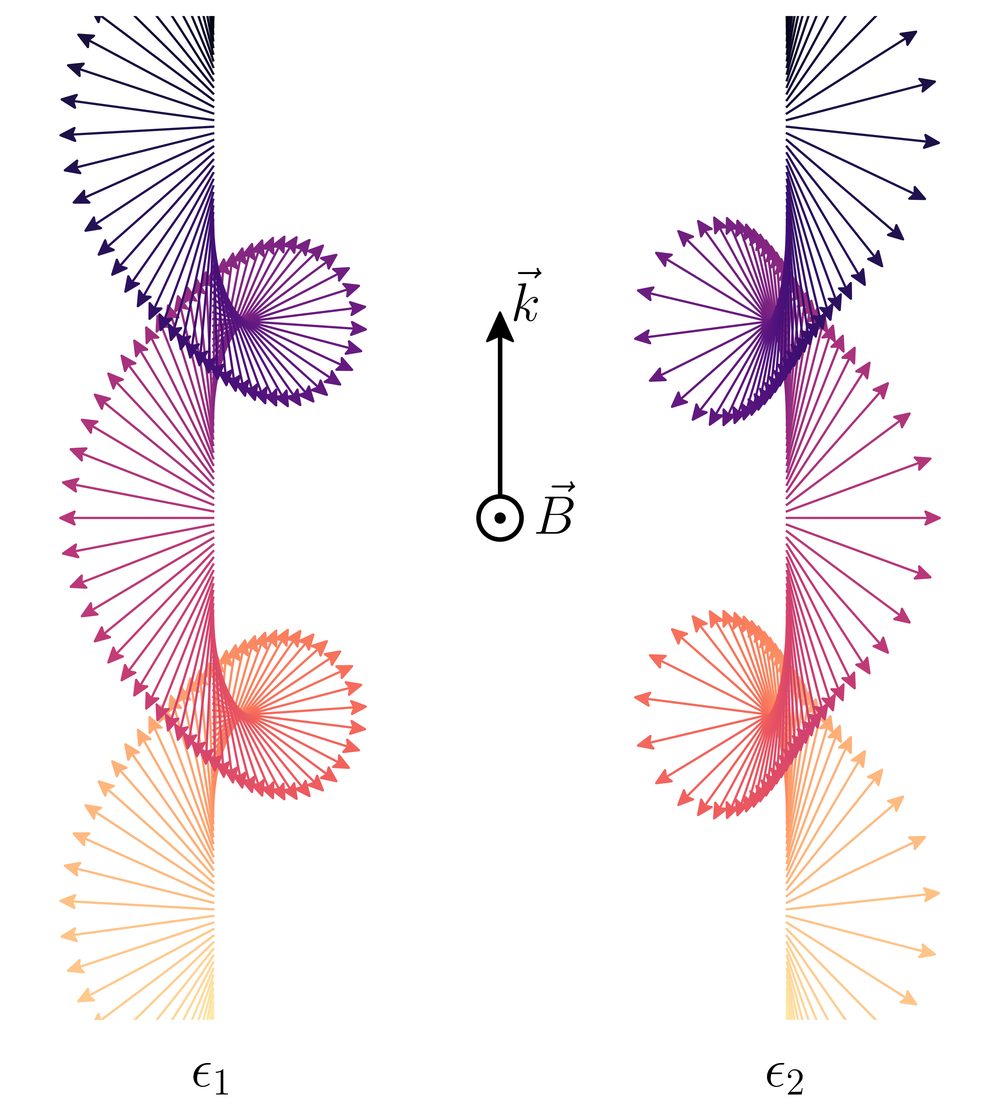
Axion and Dark Photon Production in Magnetized White Dwarfs
Axions and dark photons are among the most well-motivated extensions of the Standard Model, and their production can be efficient in the hot, dense plasmas inside stars. Almost all of the existing stellar limits on these particles, though, assume an unmagnetized, isotropic plasma. In this work we showed that the photon self-energy in a magnetized plasma is qualitatively very different than an unmagnetized one, primarily because of the local anisotropy imparted by the background field. We considered magnetic white dwarfs as a case study and found that in large volumes of these stars, resonant production of beyond-Standard-Model particles can be enabled purely by the presence of a magnetic field, with multiple plasma modes contributing simultaneously at different radii. We found that magnetic fields change the energy and regions of dark photon and axion production, increasing the regions where the production of these particles is allowed and changing the energies of emitted particles. The local emissivity is in some limits very different from what one would obtain using unmagnetized dispersion relations, which motivates revisiting astrophysical constraints on light bosons in any system where the cyclotron frequency is comparable to or larger than the plasma frequency.
E. Iles, S. Heeba, K. Schutz — Physical Review Letters 134, 121002 (2025) [arXiv:2407.21096]
Direct Detection of the Millicharged Background
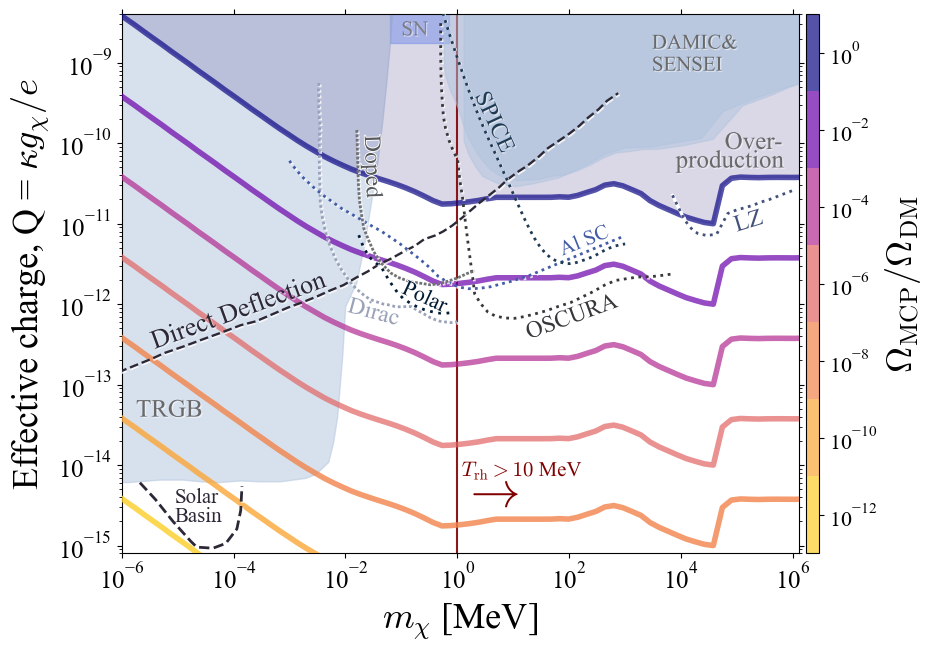
You’ve likely heard of the cosmic microwave background (CMB) — a faint afterglow from the Big Bang that provided one of the most compelling pieces of evidence for the origin of our universe. In this study, we considered another type of cosmic background that could exist, made up of millicharged particles (MCPs) which are particles with tiny, fractional electric charges, far smaller than the electrons. These particles don’t exist in the Standard Model of particle physics, but they appear in many beyond the standard model (BSM) theories. Importantly, MCPs are a well-motivated candidate for dark matter.
In this study we showed that if MCPs exist, they would have been created in the early universe because of their tiny electric charge. This work showed that even if the MCPs make up only a small fraction of the dark matter, they would still have been produced in detectable quantities through ordinary particle reactions in the hot, dense plasma following the Big Bang. These particles would still be drifting through the universe today, forming a cosmic background of millicharged particles, much like the CMB. This discovery is especially exciting because, thanks to their tiny electric charge, MCPs could interact with electric fields making them potentially detectable in upcoming terrestrial experiments searching for dark matter. Many existing and planned dark matter detectors are already sensitive enough to detect this potential MCP background or rule it out. In short, this study shows that a wide array of future experiments could discover or constrain a universal background of MCPs even if their abundance is much smaller than previous works have assumed.
D. Sarkar, E. Iles, A. Liu — submitted to Physical Review D [arXiv:2512.09984]
Novel Statistical Estimators for Line Intensity Mapping
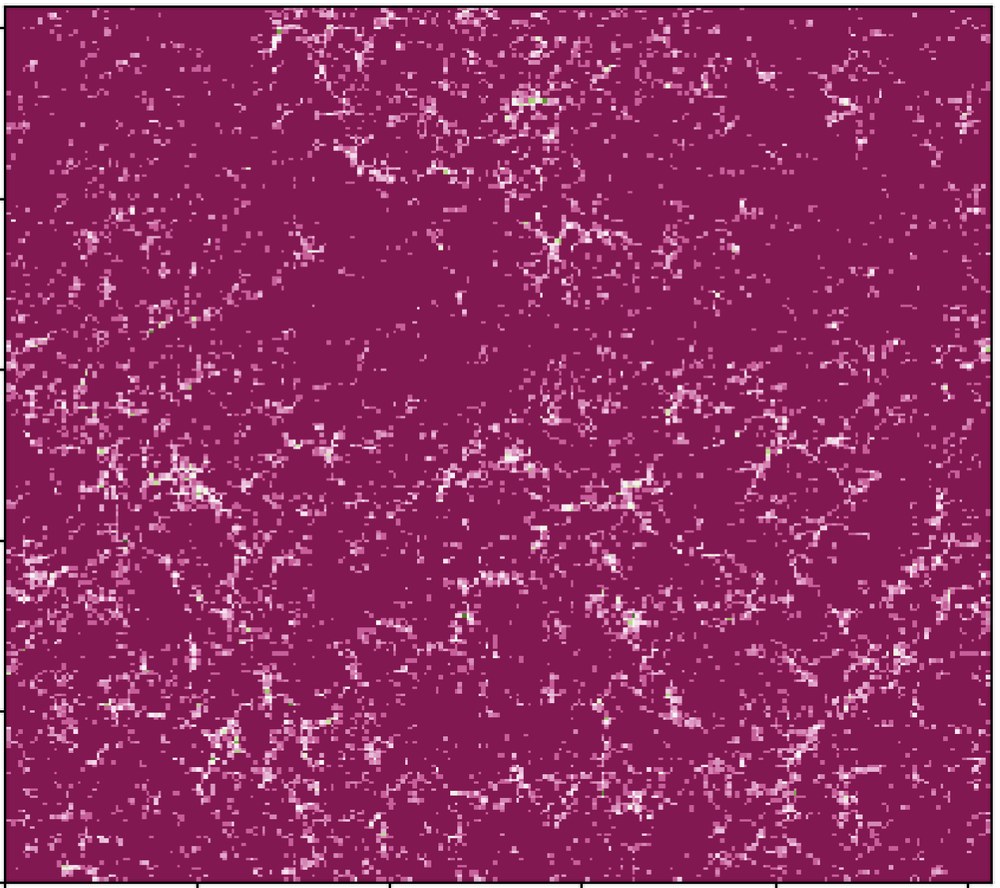
Line intensity mapping (LIM) uses spectral lines emitted from galaxies and other regions as a way to learn about matter in the universe at a variety of redshifts. The auto power spectrum of these spectral lines is a useful quantity but the data is often limited by instrumental noise, residual foregrounds, and systematics. Cross-power spectra between multiple lines offer a robust alternative to infer the auto power spectrum. Inferring the auto spectrum from cross-correlations relies on two key assumptions: that all tracers are linearly biased with respect to the matter density field, and that they are strongly mutually correlated. In this work we introduced a new diagnostic statistic, Q, built from combinations of cross-spectra between four different spectral lines, which serves as a data-driven null test of those assumptions. We validated it on both analytic toy models and simulations of LIM observables across a range of redshifts and noise. We found that the criterion Q ≈ 1 reliably selects the regions where cross-spectrum estimators are valid, while significant deviations indicate that the key assumptions have been violated. This gives astronomers a convenient way to define the scale cuts and redshift ranges over which these reconstructions can be trusted.